VMotionX
Type a prompt → 3D motion for characters and robots → export for your DCC or rig. Fully offline.
- Fully offline
- Real-time viewport
- One rig, fully capable
- BVH / DCC export
- Characters + robots
VMotionX is a desktop authoring tool that turns a plain-text prompt into 3D motion you can pose, retime, extend, constrain, and export as standard animation data, with no cloud, no runtime internet, and no Python. It started as a character-animation tool, but the motion it authors is really joint trajectories on an articulated rig, so the same workflow reaches beyond human characters toward robotics: humanoids and other articulated systems. The generation engine runs entirely on the local machine behind a purpose-built native pipeline.
The goal is a small, self-contained studio. Start from a sentence, then treat the result like any other clip: keyframe it, interpolate it, route it through an environment, and hand clean motion to Blender, Unreal, Unity, or a robotics pipeline.
The tool
Live capture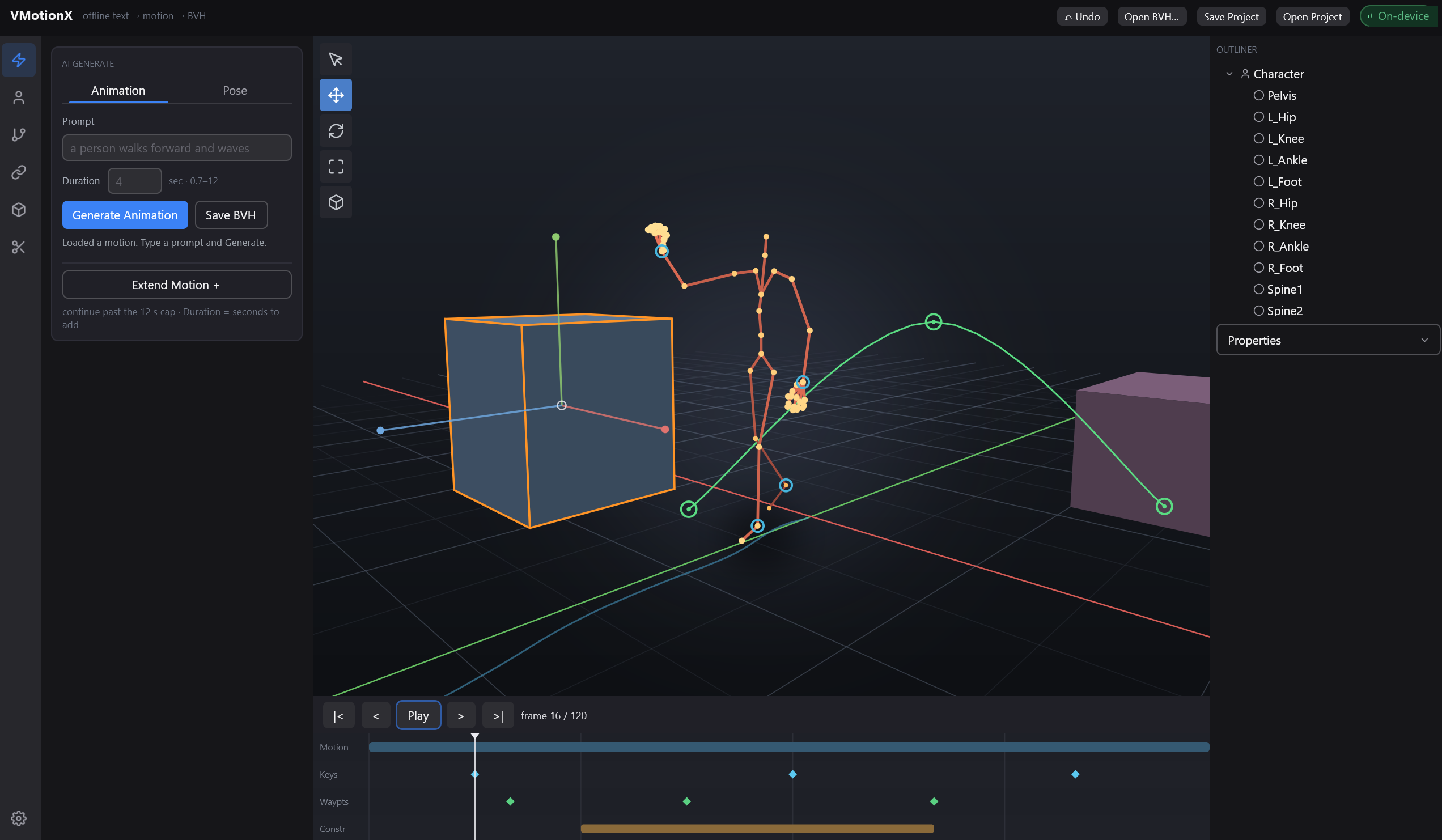
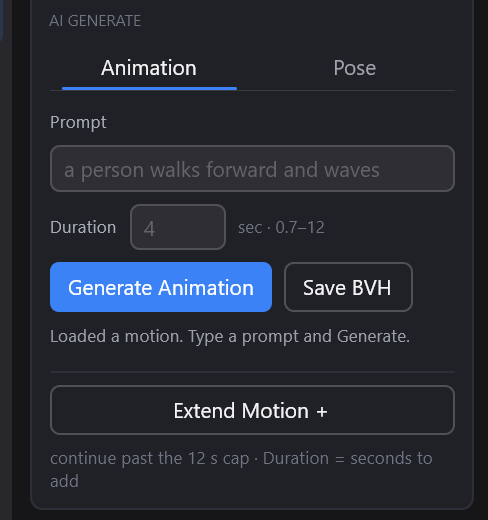
- 1Prompt panel. Describe a motion and generate it, capture a single pose, or extend a clip past its single-shot length.
- 2Direct manipulation. Move / rotate / scale gizmos and per-joint IK handles, the same muscle memory as any DCC.
- 3Environment props. Block out a scene with boxes, then snap heights and contacts to real geometry.
- 4Waypoint path. Route the root through space with per-point height pins for jumps and climbs.
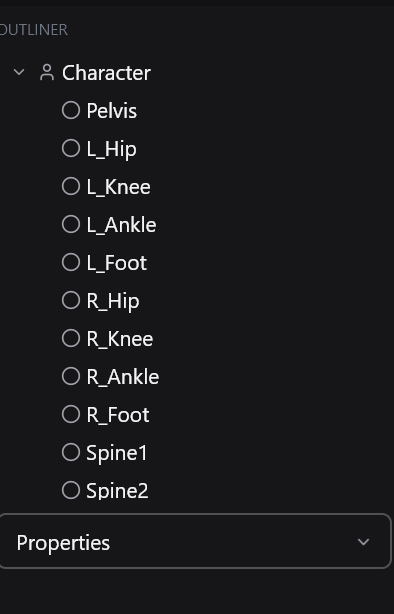
- 5Outliner. The full articulated rig, every joint selectable and drivable.
- 6Multi-lane timeline. Motion, keyframes, waypoints and constraint spans on one integer-frame timeline.
How it works
High level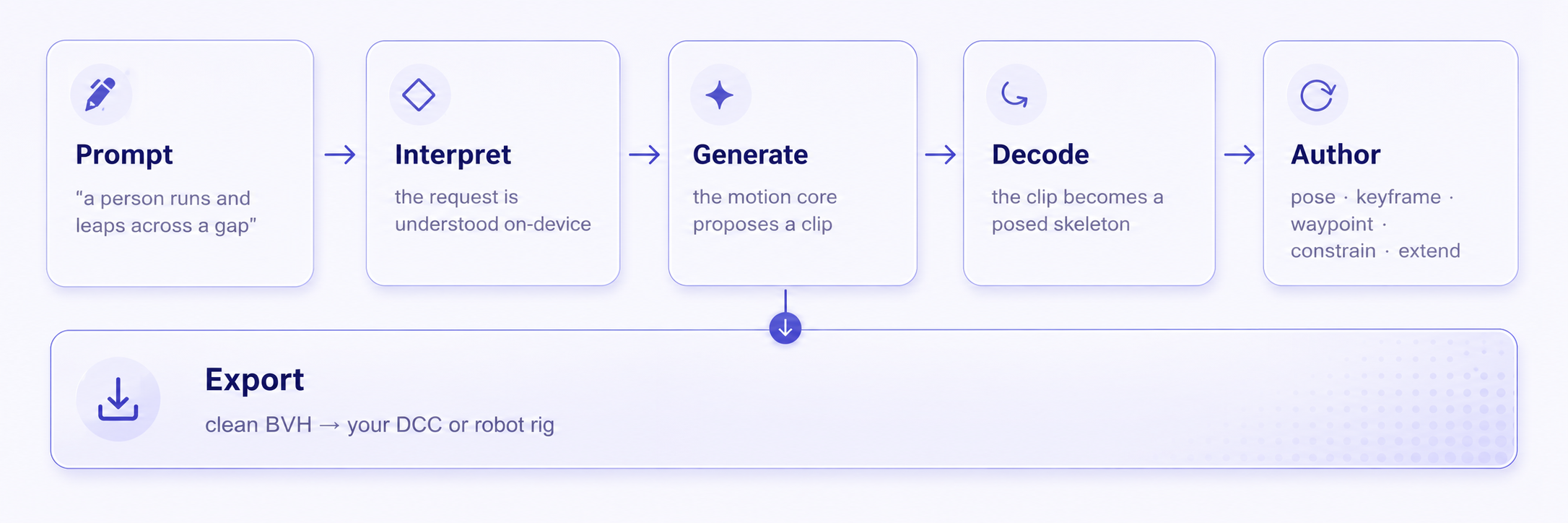
⟳ Authoring feeds back into generation: pin what you like, then re-generate the rest under those constraints.
Note: the Interpret, Generate, and Decode stages run entirely on your machine. Their internals are proprietary and deliberately abstracted here.
What it does
Prompt → motion
Describe an action in plain language and get 3D articulated motion back, for a character or a robot rig, generated entirely on-device.
Pose & keyframe authoring
Select any joint, dial in a pose, and capture keyframes straight from the viewport.
Interpolate between poses
Blend captured poses into smooth, in-betweened motion with easing you control.
Extend past the clip limit
Continue a motion beyond the model’s single-shot length and stitch the pieces together seamlessly.
Waypoints & foot constraints
Route the subject along a path, pin jump heights, and lock feet or end-effectors to kill skating and drift.
DCC-style transforms
A familiar move / rotate / scale workflow, with gizmos, an icon tool strip, and modal shortcuts.
Screens
From the running build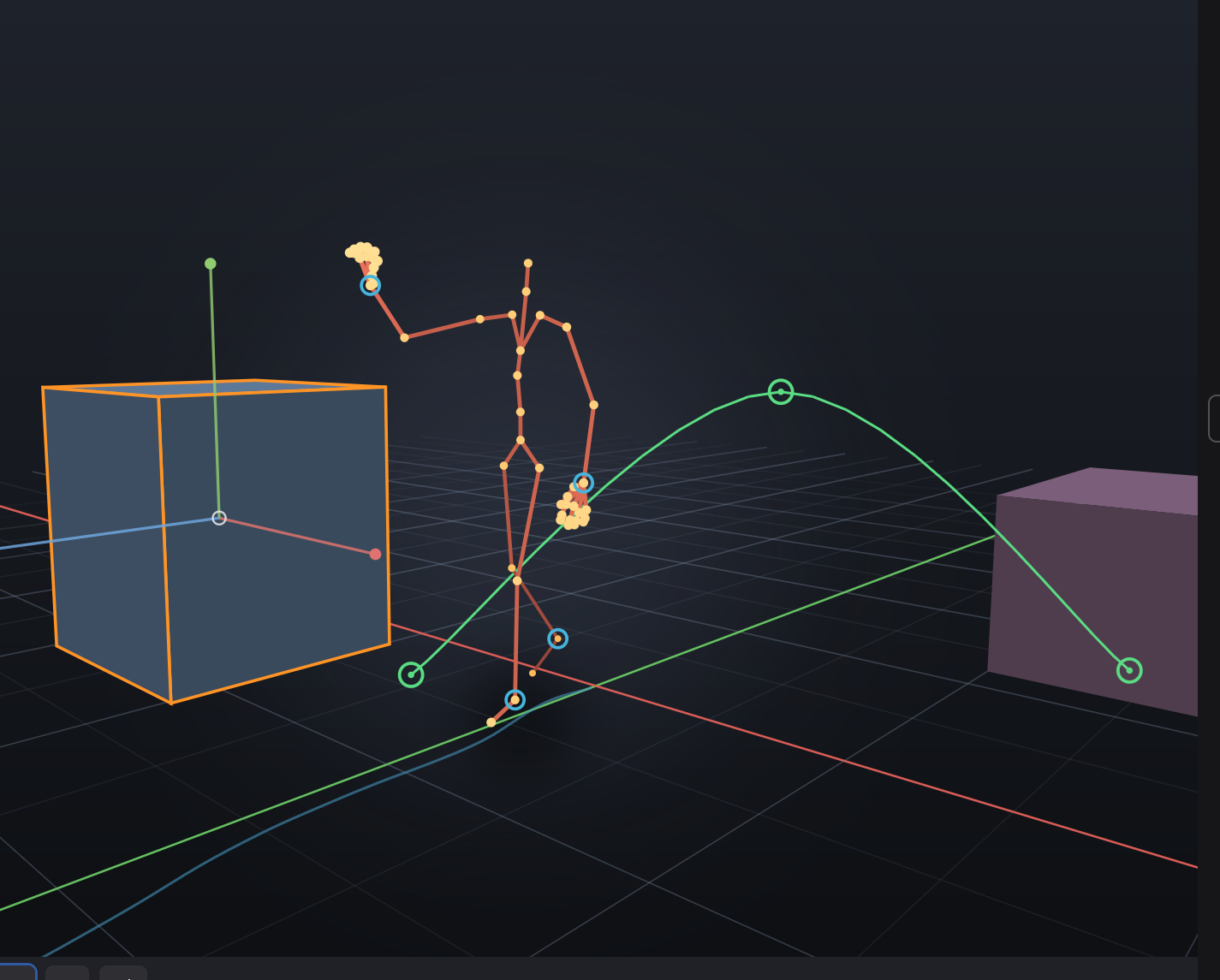

Design principles
Offline by default
No cloud, no runtime internet, no Python. The whole pipeline runs on the local machine, so the work stays private and the tool keeps working on a plane.
Author, don’t just generate
Generation is the first frame of the workflow, not the last. Every result is editable like a normal clip, so intent survives the model.
One rig, done properly
A single skeleton taken all the way (pose, interpolate, constrain, extend) before scaling out to crowds. Depth over breadth.
Skeleton-native
Everything is standard rotational animation data, so it round-trips to any DCC and retargets toward robot joint rigs.
Under the hood
Approach, not internalsA native core, no runtime
The generator, the viewport, and the exporter are one self-contained native application. Nothing is downloaded or spun up at use time.
Generate, then honor constraints
The motion core proposes; a constraint layer then pins roots, feet, keyframed poses, and end-effector targets so the authored intent is what actually ships.
Beyond the single-shot limit
One generation is length-capped. Longer motion is built by pinning a prefix, generating a continuation, then rigid-aligning and crossfading the seam so it reads as one take.
Verifiable output
Every generated clip is checked against its own constraints before it is accepted, and exports pass an automated import gate in a real DCC.
What’s next
- Retarget presets for common character and robot rigs
- Multi-character scenes with interaction constraints
- More export targets (USD, glTF, robot description formats)
- Physics-aware foot and contact refinement
Status
Actively developed. The generation engine and core authoring loop are working; the interface and export polish are ongoing. Not open source.